For accounts payable software buyers, the quality of the connections now carries more weight than the size of the price tag.
That shift runs through “Who Decides Now,” the July edition of the Business Payments Tracker from PYMNTS Intelligence and WEX. The report finds that developers, IT teams and implementation specialists are gaining influence as companies choose embedded payment systems. Finance leaders still focus on cost, control and efficiency.
We’d love to be your preferred source for news.
Please add us to your preferred sources list so our news, data and interviews show up in your feed. Thanks!
Technical teams bring a second test: Can the platform connect with existing accounting and enterprise resource planning systems, go live without prolonged disruption and keep working as payment volume grows? The integration layer works like plumbing in a new building. Buyers may admire the features, but daily operations depend on reliable connections behind the walls.
Key Findings:
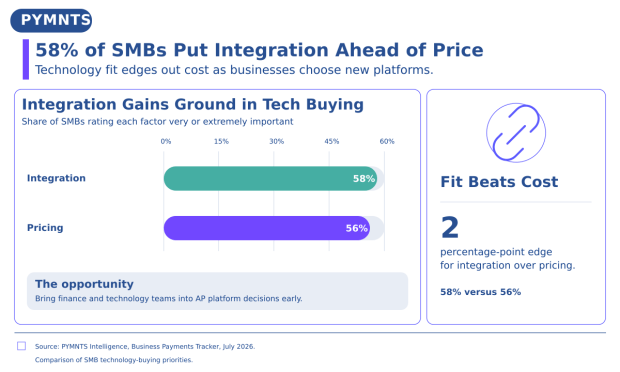
- Integration edges out price. Fifty-eight percent of small to medium-sized businesses (SMBs) rate integration as very or extremely important when evaluating technology, compared with 56% that say the same about pricing. The 2-percentage-point lead is narrow, but may signal that buyers increasingly view compatibility as a business requirement rather than a technical detail to address after selection.
- Implementation shares the top tier. Among people who influence AP automation purchases, 40% cite easy integration as a leading factor. The same share names an easy implementation process and proven return on investment, while 37% point to workflow efficiency. That puts the experience of installing and operating a system alongside its financial case.
- Automation still has room to deliver. Although 89% of organizations use at least some AP automation, half continue to process more than 5,000 invoices a month through workflows that aren’t fully automated. Integration difficulties rank as the second-largest automation concern at 49%, just behind cost at 50%. Better connections could help companies convert existing software spending into more complete automation.
The potential payoff reaches beyond faster invoice processing. Ninety-two percent of AP professionals say automating invoice management and supplier payments would give finance teams more time for strategic work. Integrated systems can improve payment accuracy by as much as 40%, according to research cited in the report. They can also ease a growth constraint: 69% of organizations identify manual processes and limited automation as their biggest barrier to scaling, rising to 73% among larger companies.
The report recommends bringing technical specialists into evaluations early, reviewing documentation and testing tools alongside features and choosing systems that can adapt as volumes rise. That approach gives finance and technology teams a shared path toward AP operations that are easier to run and ready to grow.


 Add as Preferred Source