Companies using several artificial intelligence fraud tools are more likely to stop attempted theft before money leaves their accounts, offering an encouraging direction for businesses strengthening payment defenses.
That’s a central finding of “Prevention First: Building a Smarter Defense Against Payments Fraud,” a PYMNTS Intelligence report produced in collaboration with Bottomline. The September report draws on a July survey of 150 U.S. treasury and finance executives at companies with at least $100 million in annual revenue. It finds that stronger fraud protection combines technology with reliable supplier verification and payment controls. AI can help identify suspicious activity, but companies still need to confirm who they’re paying. Think of those checks as several locks on the same door, each providing another opportunity to stop an intruder.
We’d love to be your preferred source for news.
Please add us to your preferred sources list so our news, data and interviews show up in your feed. Thanks!
Three findings show where businesses are making progress and where they have room to improve:
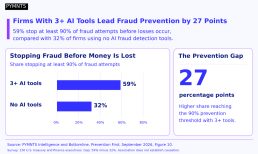
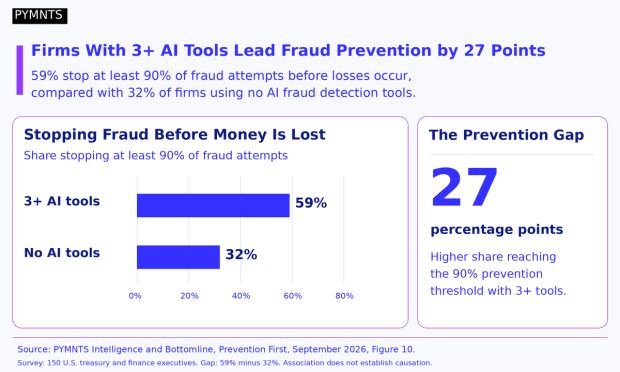
- Broader AI use accompanies stronger prevention. Among firms using three or more AI fraud detection tools, 59% stop at least 90% of fraud attempts before any loss occurs. Just 32% of firms without AI tools reach that threshold, a 27-percentage-point gap. The survey doesn’t establish that AI alone causes the difference. It does show that companies combining several tools report stronger results. Among AI adopters, 77% say the technology outperforms their previous methods, though the report cautions that this finding comes from a small subgroup.
- Basic supplier checks remain central. Before adding a vendor or changing banking details, 82% of firms require approval from more than one person and 80% compare requests with contact or banking information already on file. Those precautions address a common threat: Half of respondents reporting an AI-enabled fraud tactic identify vendor impersonation emails as the tactic they encounter most often. Verifying a payment request against trusted records gives employees a practical way to challenge a convincing message.
- Companies without AI defenses are preparing to adopt them. Among non-users, 58% are implementing AI fraud detection or plan to do so within 12 months. Their concerns help explain the remaining hesitation. Some 89% fear flagging legitimate payments and 74% hesitate to automate without human approval. Adoption will require confidence that new tools can protect payments while keeping routine business moving.
The report also finds that prevention remains demanding work. Some 89% of finance leaders describe vendor verification as a moderate or major burden, while 78% say the same about reconciling payments and accounts. Companies are directing investment toward those needs: 81% expect to adopt or improve automated vendor checks at setup and 75% plan to strengthen bank account verification before payment. Those priorities put practical improvements at the center of fraud defense.
At PYMNTS Intelligence, we work with businesses to uncover insights that fuel intelligent, data-driven discussions on changing customer expectations, a more connected economy and the strategic shifts necessary to achieve outcomes. With rigorous research methodologies and unwavering commitment to objective quality, we offer trusted data to grow your business. As our partner, you’ll have access to our diverse team of PhDs, researchers, data analysts, number crunchers, subject matter veterans and editorial experts.


 Add as Preferred Source