Business leaders are not giving up on clearer conditions, but their confidence is no longer rising in a straight line.
That is one of the revealing signals in “Forecasting Under Pressure: New Data Shows Uncertainty Is Still Running High,” a PYMNTS Intelligence report from The 2026 Certainty Project. The report showed that companies are still trying to forecast through fast-changing conditions, with newer geopolitical stress replacing last year’s tariff disruptions as the source of pressure.
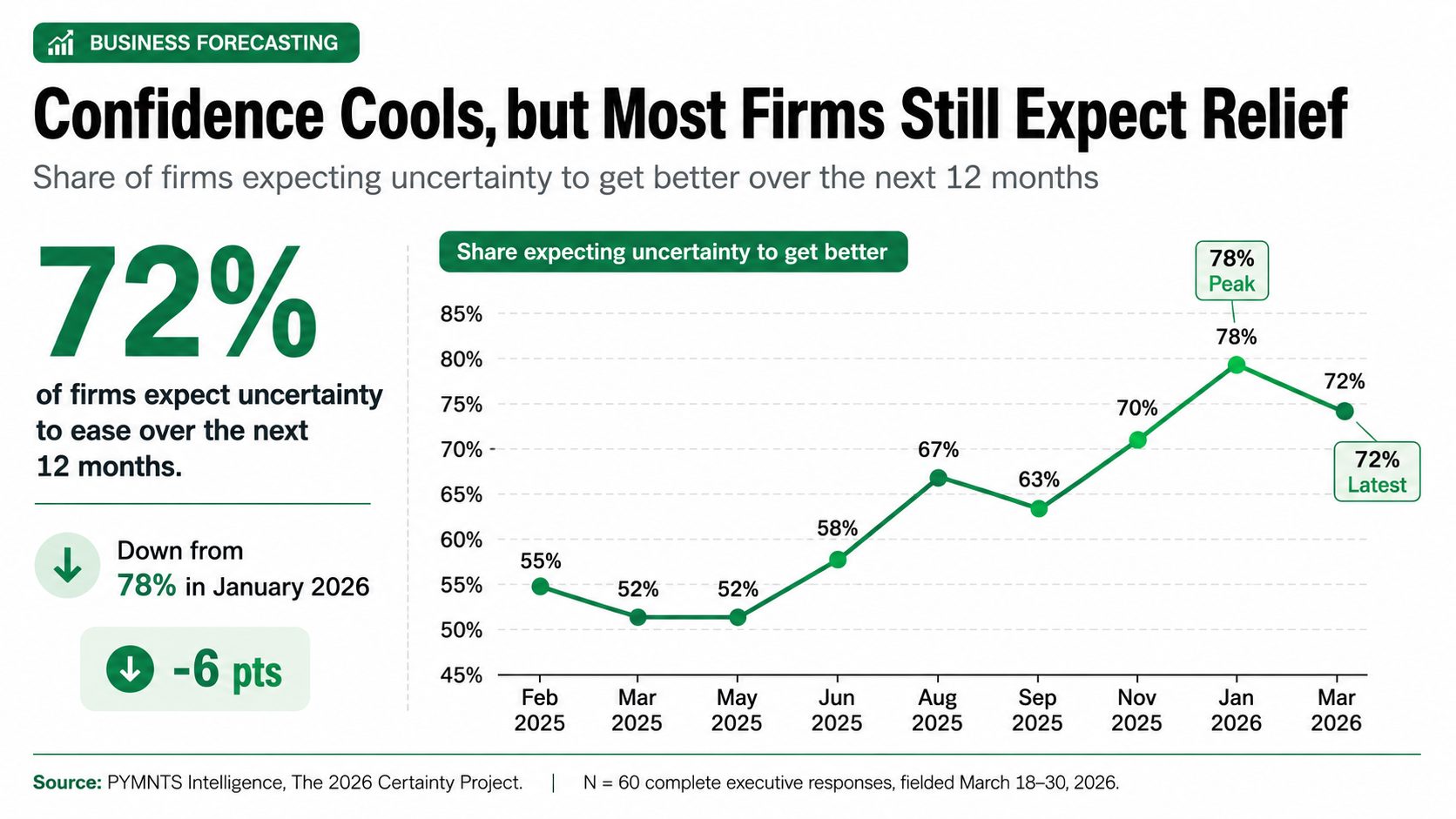 In March, 27% of heads of payments said their firms faced a high level of uncertainty, while 72% said they expected uncertainty to decline over the next 12 months. That is still a strong majority, but it was down from 78% in January, suggesting that optimism remains intact but has become more cautious.
For finance leaders, that shift is important. Forecasting is not just an annual planning exercise. It shapes pricing, cash flow, inventory, capital spending and the timing of payments.
We’d love to be your preferred source for news.
Please add us to your preferred sources list so our news, data and interviews show up in your feed. Thanks!
When confidence cools, companies may still invest, hire and expand, but they are more likely to do so with tighter controls and shorter planning windows.
The report’s data pointed to a business environment where executives see improvement ahead, while still preparing for turbulence.
- In March, 27% of firms reported a high level of uncertainty. That puts the latest reading close to earlier periods of tariff-related disruption, even though the source of concern has changed.
- Among goods firms, 47% reported high uncertainty. Goods companies remain more exposed than services firms because they are more directly affected by supply chains, input costs, inventory timing and shifts in demand.
- The share of payments leaders who said uncertainty will get better over the next 12 months was 72%. That was down from 78% in January, but still above the 55% reading from February 2025.
The positive angle is that most firms are not treating today’s volatility as permanent. Even after a softer March reading, nearly three-quarters of respondents said they expect conditions to improve. That suggests business leaders are learning to operate through uncertainty rather than freeze in place.
Still, the cost of operating in this environment remains uneven. The report found that the total financing cost of uncertainty stood at 2.9% of revenue over the past year. Firms facing high uncertainty reported costs equal to 6.2% of revenue, more than double the average. Goods firms also remained more exposed than services firms, reinforcing the idea that volatility does not hit all sectors in the same way.
The broader takeaway is that business forecasting has entered a more demanding phase. Companies are not planning for one disruption to end before returning to normal. They are planning for a market where new shocks can arrive before the old ones fully fade.
The hopeful sign is that most executives still see relief ahead. The practical lesson is that finance leaders may need forecasting models built for movement, not stability.
At PYMNTS Intelligence, we work with businesses to uncover insights that fuel intelligent, data-driven discussions on changing customer expectations, a more connected economy and the strategic shifts necessary to achieve outcomes. With rigorous research methodologies and unwavering commitment to objective quality, we offer trusted data to grow your business. As our partner, you’ll have access to our diverse team of PhDs, researchers, data analysts, number crunchers, subject matter veterans and editorial experts.


 Add as Preferred Source