The Pink Skirt Problem: Why AI Agents Can’t Own Serendipity
The best thing I ever bought while shopping for a blue blazer was a pink skirt.
One evening I went hunting online for the blazer. I knew exactly what I wanted. The cut, the fabric, the shade of blue (not too light, not too dark), the designers in my consideration set and the amount I was willing to spend to buy it. Then right as I was comparing a few choices, a pink skirt caught my eye. It was styled with an outfit I’d never have assembled, in a color I never would have typed into a search box, paired with a grey linen jacket that happened to be the doppelganger of one already hanging in my closet.
Suddenly I wanted that skirt more than the blazer I had organized my shopping adventure around. I had room in the budget for one or the other. Guess what? The skirt won. The blue blazer is still out there somewhere, unbought. At least by me.
That’s serendipity in full swing. It’s the same experience a print magazine used to create when you noticed an ad on page 27 while flipping your way to the article on page 81, and the ad got noticed, and item advertised maybe even got bought.
There was no pink skirt in my head, on a list, anywhere. The want didn’t exist until the instant I laid eyes on the skirt. The seeing wasn’t a step on the way to the purchase. The seeing was the purchase. It created the demand I then satisfied with my purchase.
Now hold that thought against the agentic commerce experience we’re all racing to build.
The whole promise of the shopping agent is that it gets you what you asked for and never wastes your time on what you didn’t.
| The seeing was the purchase. It created the demand it then satisfied with my purchase. |
You say blue blazer, it returns blue blazers. It doesn’t show you the pink skirt because you didn’t ask for the skirt, and not asking is precisely the prompt agents are built to execute. An agent, handed my instruction, would have found blazers, compared three of them, checked my size and inventory avails and my points and the promo codes, recommended the best option and closed the sale. It would have done its job perfectly and sent me home with the best deal on a blazer that, but for serendipity, I would have bought.
That’s the agentic commerce feature. I want to argue that it’s also the bug.
What the Agent Replaced
I’ve made the case, here and elsewhere, that agents are becoming the department stores of the future, that the contest in commerce is moving from clean user interfaces to intent, and that what we have so far is, underneath the conversational gloss, a very intelligent search bar. A better one than Google, one that can strip the complexity and friction out of discovery on the way to a purchase. I stand by every word.
Read More: Department Stores of the Future Are AI Agents
But search is the path to the thing you already know you want. It isn’t the tool for changing what you’re after. And that’s limiting, because changing what you’re after has always been a big part of what shopping is. An agent can introduce you to a new blue blazer brand or a merchant you never considered. What it can’t do is serve up the pink skirt that was never in the consideration set at all.
Not doing so implies that intent was the entirety of demand. It isn’t.
Intent is the part you can already name, the part an agent can learn, and will learn really, really well. Feed it a decade of my purchases and it knows I reach for French blue and never coral, that I buy the knee length and skip the mini, that I have a number in my head before I start. That’s real, and the agents are going to be extraordinary at it.
But that profile, however complete, is a record of what I’ve already wanted. It isn’t the same as the want that doesn’t yet exist.
| And a great deal of what people buy is driven by demand that wasn’t there until something shaped it, on the spot, by showing it to them. |
And a great deal of what people buy is driven by demand that wasn’t there until something shaped it, on the spot, by showing it to them. That kind of preference can’t be retrieved, because there’s nothing to retrieve. It gets constructed, in the moment, often by accident, and often in flat contradiction of the historical precedent.
Read More: What Happens to Stores When AI Agents Do the Shopping?
The pink skirt wasn’t in my history. It’s not a color I buy regularly and would never have typed. The most complete preference file in the world for me doesn’t contain it, because it wasn’t a preference.
Until I saw it.
Ask any retailer how much being able to act on that is worth. Ask again, with me sitting there on my iPad with the blue blazer in my cart until it wasn’t.
The Demand You Never Knew You Had
Robert Merton, often regarded as the founder of modern American sociology, spent years studying exactly this. Serendipity, he argued, takes two things at once: a chance encounter and a mind prepared to seize it. Not luck alone, but luck plus a person who sees the unsought thing and instantly grasps its value.
That second half is the part we tend to overlook. He calls it the prepared mind, one that’s already primed to recognize what matters the moment it appears, even when you weren’t looking for it.
Mine was primed for the skirt. In the half-second I saw it, I knew the color worked, knew it went with a jacket already in my closet, knew it was right. Someone else scrolls past the same image and feels nothing. Same encounter, no prepared mind, no serendipity.
That sort of makes my skirt a textbook case, or test, for agentic commerce.
The encounter was unplanned. The prepared mind was mine. The agent, by design, removes the encounter and stands in for the mind, which kills both halves of what Merton described at once.
There’s no chance in an agentic world because chance is inefficiency. And there’s no prepared mind in the loop because the entire point of the agent is that you don’t have to bring one.
Why Eyes May Be an Agent’s Achilles Heel
Many of you will say this is fixable. It’s about having the right data. Learn the customer well enough and the agent surfaces the skirt too. It’s not clear if this will work, and not because of how much the agent knows. It’s that serendipity is triggered by a different kind of input than the one the agent runs on right now.
We instruct an agent in language, typed or spoken. But the want for the skirt didn’t arrive as language. It arrived through my eyes, before any words, in the half-second before I’d even been introduced to the idea of a pink skirt. Sight formed the want. By the time there were words to type, the moment that created it was already gone. The skirt was never going to make it into a prompt because a prompt is assembled out of what you already knew to say.
There’s hard science to support this. In 1980 the psychologist Robert Zajonc made the case, in a paper titled “Feeling and Thinking: Preferences Need No Inferences,” that feeling comes before thinking, that the pull toward something hits first and the reasoning comes after. And it happens fast. A 2014 study from Mary Potter’s lab at MIT found the brain can recognize an image flashed for as little as 13 milliseconds, far too quick for any second thought.
What the eye is doing in that instant, Potter would describe as finding concepts. So, by the time I could have turned the skirt into the words “pink skirt,” my brain had already seen it, already wanted it. And more importantly, already finished wanting it.
| The words come last. Scientists say that’s the order the brain runs in. |
The words come last. Scientists say that’s the order the brain runs in.
It’s why the search bar, however smart, always hit a ceiling. A search bar answers a query, and a query is something you already knew to ask.
Read More: Why AI Shopping Is Still Just a Smarter Search Bar
Now the obvious pushback. Agents can “see,” and they see very, very well. Hand a modern model a photo and it reads it back in detail: a pink midi, grey jacket, here are six like it. Very true.
But the model turned the picture into words. That’s the only thing it can do with an image, describe it and reason over the description. It isn’t what the skirt did to me. A model can read ten thousand skirts and build a finer description of each. It never does the wanting, because it has nothing to do with it. It can see the skirt in perfect detail and want none of it.
The whole design of the agent is that I no longer have to be the one looking. And that means I’m not there for the skirt to happen to.
Here’s the proof, entirely digital, of the power of serendipity and its visual impact. A majority of TikTok users say they’ve made an impulse purchase on the app, more than on Instagram or Facebook, according to a Bizrate Insights 2024 survey. Among TikTok Shop users, the share who report buying something they discovered there runs past 70%. They didn’t search for it. They saw it. A creator held it up, it was styled, it moved, and the want formed on contact. The same way mine did.
Social commerce runs on the opposite principle from the agent. In 2023, Americans spent an estimated $71 billion on purchases driven by social media, things they never set out to buy and saw their way into wanting.
The feed shows you things. The agent fetches what you named. Both are digital. But only one of them puts a person in front of the thing while the person is still doing the looking.
And that’s the only place the pink skirt can happen and get bought.
Why Personalization Isn’t Serendipity
Now, let’s say you tell the agent to find terracotta pots for your garden. The agent returns several selections of said pots in assorted sizes and prices. Along with them comes recommendations on potting soil, garden gloves and the slow-release pellet fertilizer you didn’t think to name but clearly need for this garden project.
An incredibly helpful agent does exactly what agents are built to do. Every one of those recommendations is directly related to the thing you asked for. Pots imply soil and fertilizer. Planting implies dirty hands, which imply garden gloves. The agent didn’t invent a want. It unpacked the ones already riding alongside the want you stated at the prompt. And it does this better than any human clerk because the logical connections of a stated intent are exactly what a machine infers well.
Some call it personalization. For purposes of this conversation, let’s call it adjacency.
The pink skirt wasn’t adjacent to anything. The gloves were reachable from the pots by a chain of need, and the agent walked the chain in milliseconds. There was no chain from a blue blazer to a pink skirt. The skirt didn’t serve the blazer, didn’t complete its outfit, didn’t follow from the prompt that drove my search in the first place. No amount of reasoning over my stated intent arrives at it, because it isn’t tied to my stated intent by any thread the reasoning could pull.
Adjacency extends what you already wanted. Serendipity replaces it.
The agent is built to do the first. It structurally can’t do the second.
Where Agents Excel and Where Serendipity Still Rules
I took a stab at organizing commerce, and its AI-powered evolution, into a framework that helps to establish where agents excel (stated demand/intent) and where they fall short (created demand/influence). The first force is intent, how clearly you already know what you want. The second is influence, how much being shown something formed the want and created demand that didn’t exist before.
When put on two axes, four kinds of shopping and buying fall out. And the agent behaves completely differently in each.
High intent, low influence. You know what you want and no one had to show you. Garden hoses. The flight home from dropping the kids off at camp. The same moisturizer you’ve bought for six years. This is the agent’s home ground, and it does this faster and better than you ever could. Frictionless here is a pure gift. Agents rule.

We’d love to be your preferred source for news.
Please add us to your preferred sources list so our news, data and interviews show up in your feed. Thanks!
 Add as Preferred Source
High intent, high influence. You can name the want now, but you couldn’t have a month ago, something put it there. You saw a friend’s air fryer, read the reviews for a week, and now you type “Ninja Crispi” into the agent to get the best deal. The wanting was created by influence, the friend, the reviews, but by the time it reaches the agent it has hardened into a product name. The agent looks like it served your intent. In fact, it just satisfied a want that something else already built.
Low intent, high influence. The pink skirt. You weren’t shopping for it, you’d never have typed it, and the only reason you own it is that you saw it. The want was made whole in the instant of seeing, and you couldn’t have stated it in advance because there was nothing there to state. This corner is the one the agent can’t enter, at least not yet. The agent honors what you asked for and strips out everything you didn’t, and this corner is made of nothing but the things you didn’t ask for.
Low intent, low influence. No goal, nothing’s grabbed you, you’re killing ten minutes in a store or the subway ride home. The aimless wander where a lot of discovery used to start. The agent has nothing to do here, because there’s no intent to serve yet and nothing has moved you. So in an agentic flow it barely happens anymore. It’s the browsing the agent mutes just by existing.
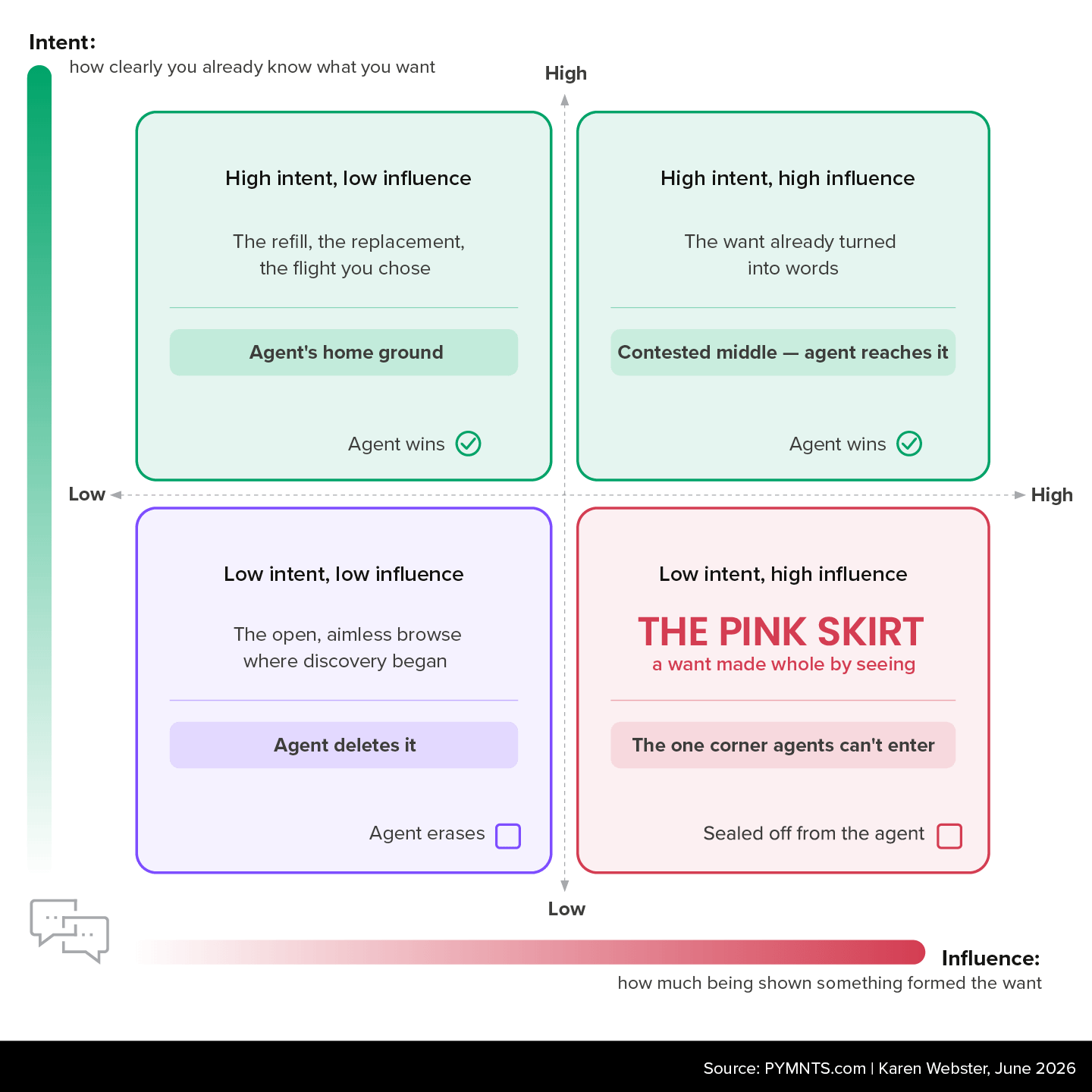
Now, step back and look at the four together and the intent/influence/serendipity agentic commerce story begins to unfold.
The agent lives in the left column, where influence is low and intent does the work. The skirt lives alone in the bottom-right corner, all influence, no intent. Everything the agent is good at sits on one side of the line. Everything that runs on being shown something sits on the other.
Is Serendipity Dead or Just Getting More Interesting?
One version of the story ends here, and it’s the version I almost wrote. Serendipity can’t live in the agent layer, where intent at the prompt drives transactions and influence is the thing being deleted. It can’t live in the machine-to-machine layer now being built, where two agents reconcile a stated intent against a catalog and there’s no eye in the loop, nothing that sees and then wants. Serendipity survives only where a human eye is still doing the looking, pushed upstream of the agent entirely, to the visual moment before anyone opens anything.
Pinterest’s multi-billion dollar bet on visual search seems to support this. The shopping agent, by its architecture, can’t.
But I don’t think that’s where the story ends.
The skirt didn’t materialize from thin air. Someone made it, in that color. A buyer chose to stock it. A merchandiser styled it with that grey linen jacket and not some other one. None of that was an accident. Stores have always planned inventory to capture exactly this spend. They read the styles, the trends, the weather, the shape of who their customer is, and they place bets on the unsought thing, the item nobody walked in for but that a certain kind of person walks out with. The skirt exists because the data said someone like me would fall for it.
| Serendipity, at the level of the rack, is manufactured. It always has been. |
Serendipity, at the level of the rack, is manufactured. It always has been. The store or the site is already running the model.
Read More: When Chatbots Replace Search Bars, Who Wins at Checkout?
What the store doesn’t have is the important context. It doesn’t know that this particular woman, on this particular night, was looking for a blue blazer with budget for one thing, and that the jacket they styled the skirt with was the cousin of something already in her closet, which is the precise reason the outfit caught and held her. And ended up in her closet.
The aggregate bet on the pink skirt is theirs. The specific moment in time that I saw it and bought it was mine.
Serendipity has always lived in the gap between the two, between the want a system can predict across thousands of people and the want it can trigger in one of them, here, now, at the instant of seeing.
That gap is the whole question facing the agentic commerce future, and it’s a question of data and timing, not luck or chance. A system that held enough of me, my eye, my closet, the colors I reach for and the ones I never would, the budget I’d set, could in principle close the distance the store or the site can’t. It could put the unsought thing in front of me at the one moment I was ready to be taken by it.
That’s not impossible. It’s what serendipity already is, the prepared mind and the chance encounter, arranged. The French scientist Louis Pasteur, who made his great discoveries by noticing what an accident had put in front of him, said it best in 1854. In the fields of observation, chance favors the prepared mind.
The store or the site supplies the encounter. What it can’t supply is the prepared mind. A system that knew me well enough could.
So, the question may not be whether it can be built. It can. The question is who would build it. And the answer is that it may not be the people racing to win agentic commerce right now. Not the shopping agents, and not the players sprinting toward frictionless, because the thing they’d have to restore, the unrequested visual encounter aimed at a specific prepared eye, is the exact friction their whole business exists to remove.
They’re optimizing the column where intent does the work. The skirt lives in the corner where intent is absent and being seen is everything. And you don’t reach that corner by getting better and better at returning only what was asked.
You reach it by doing the one thing the agent isn’t built to do. Put something unasked-for in front of a human eye, at the moment that eye is ready, with enough knowledge of the person to know that it is.
So where does the value end up? The agent will take the intent column and serve it better than anything we’ve ever seen. What it can’t take, or rather what it won’t reach because reaching it runs against everything it’s built to do, is creating the want before it showed up at the prompt.
And that turns out to be a problem of knowing one person so deeply and timing one moment so exactly. Putting something unasked-for in front of them at the moment they’re ready to want it.
Until NEXT time.
Join the 21,000 subscribers who’ve already said yes to what’s NEXT.

PYMNTS CEO Karen Webster is one of the world’s leading experts in payments innovation and the digital economy, advising multinational companies and sitting on boards of emerging AI, HealthTech and real-time payments firms, including as a non-executive director on the board of Sezzle, a publicly traded BNPL provider. In 2009, she founded PYMNTS.com, a top media platform covering innovation in payments, commerce and the digital economy. Webster is also the author of the NEXT newsletter and a co-founder of Market Platform Dynamics, specializing in driving and monetizing innovation across industries.