The old question in B2B logistics was simple: How fast can the shipment get there?
The new question is more complicated. And it centers on what the shipment can tell a business while it is moving. Across freight markets, delivery mechanisms are becoming data mechanisms.
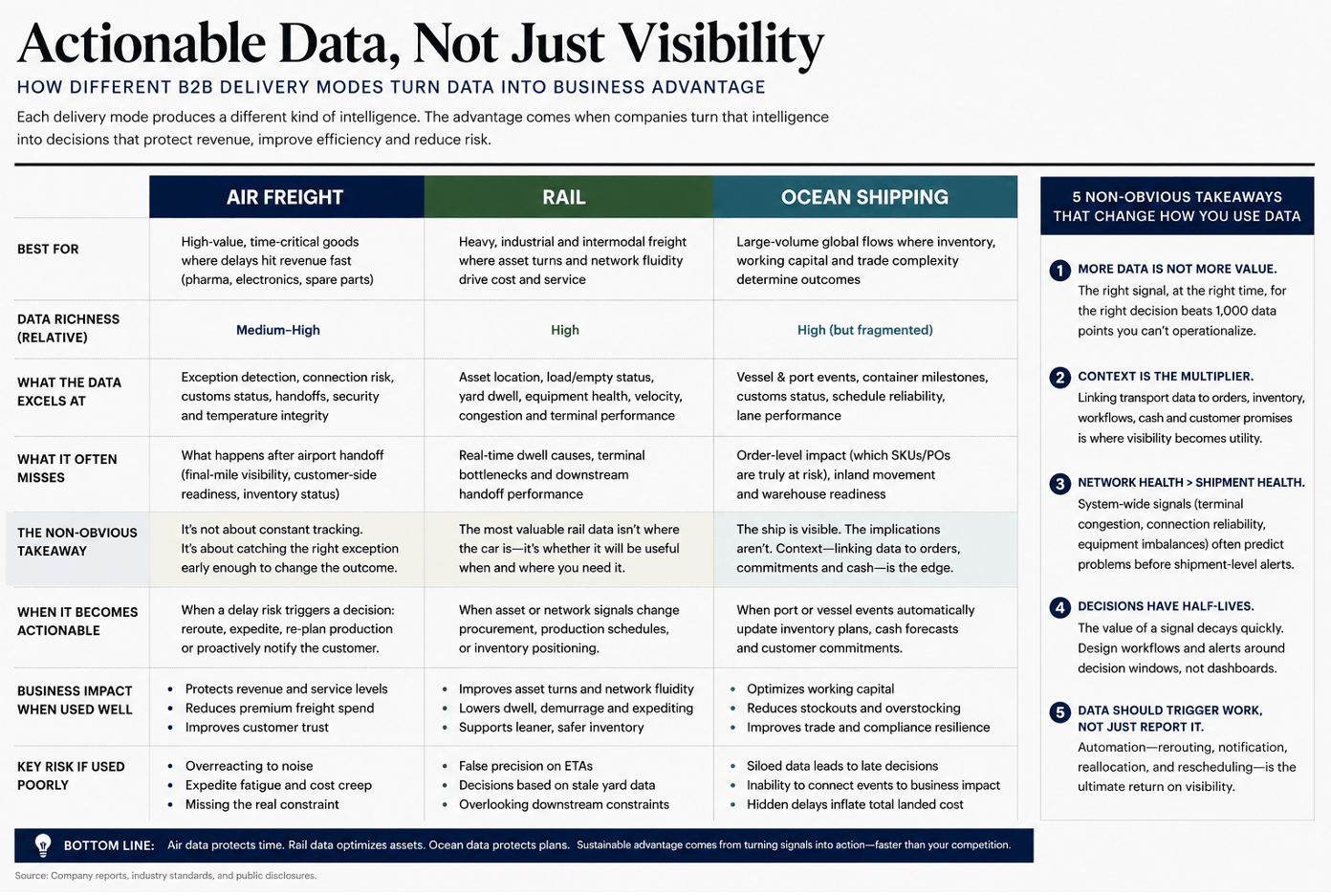
Air cargo, rail, ocean shipping and drones each create a different version of visibility. Some modes produce better location signals. Others produce richer data around condition, capacity, asset utilization, handoffs or exceptions. The point is no longer just to know where freight is. It is to know what that movement means for production, inventory, customer commitments, cash flow and risk.
But while a dot on a map may reassure a customer it does not, by itself, change an operating plan. The value comes when transportation data tells a company whether to reroute freight, adjust labor, notify a buyer, rebalance inventory, release payment or move working capital out of limbo.
See also: B2B Procurement’s Future Belongs to Companies That See Risk First
The New Freight Advantage Is Actionable Data
The old procurement win was negotiating the lowest unit price or freight rate. The new win is knowing the full cost curve early enough to act. Ocean freight may look cheaper than air and rail may look more economical than trucking, but the real cost now includes dwell, inventory buffers, stockout risk, warehouse labor changes, customs delays, insurance, duties and the cost of expediting after a plan breaks.
In B2B logistics, the question is no longer whether a company can see freight in motion. It is whether the company can turn that visibility into a better decision before the business feels the pain.
Findings in the April 2026 edition of The 2026 Certainty Project from PYMNTS Intelligence reveal that, for companies that manufacture, transport, warehouse or sell physical goods, volatility is no longer episodic. It is structural. Tariffs shift with elections and court decisions, shipping lanes close because of regional conflict, while industrial policy rewrites sourcing economics overnight.
The report found that 27% of firms overall report high levels of uncertainty, that figure rises to nearly half of goods firms (47%).
We’d love to be your preferred source for news.
Please add us to your preferred sources list so our news, data and interviews show up in your feed. Thanks!
See also: Big Tech Is Rewriting Procurement. The Rest of B2B Is Next
CFOs Are Treating Freight in Motion as a Working Capital Problem
Freight data is becoming the shared operating language between procurement and finance. A late shipment is not just a logistics event. It may be a revenue event, a margin event, a working-capital event or a supplier-risk event. A port delay can change inventory availability, a rail dwell issue can affect production and an air freight exception can determine whether a customer commitment is kept or broken.
This is where many visibility projects fall short. They make logistics teams more informed but leave finance working from stale assumptions. The CFO sees the effect later, when margins compress, inventory misses plan or cash conversion deteriorates.
That reality is forcing a deeper integration between transportation data and financial planning. Freight signals need to feed cash forecasting, inventory valuation, payables strategy, borrowing decisions and customer revenue expectations.
PYMNTS Intelligence and Visa research showed that cash flow certainty is linked to confidence in growth. When finance leaders can trust their liquidity position, they are more willing to invest, extend supplier terms and accelerate payroll or vendor payments without fear of shortfalls.
Read also: How CFOs Can Manage for Today’s Supply Chain Choke Points
The market environment reinforces the point. Recent supply chain reporting has highlighted how geopolitical instability, shipping-cost volatility and trade friction continue to pressure procurement decisions and consumer goods pricing. Separate supply-chain coverage has also underscored that resilience often depends less on having more options in the abstract and more on knowing what is in stock, in transit or in the pipeline.
The PYMNTS Intelligence report “The Investment Impact of GenAI Operating Standards on Enterprise Adoption,” a collaboration with Coupa, showed that 75% of companies are now considering using AI in procurement.
Ultimately, the logistics landscape is being shaped by the business backdrop that supply chain optionality without visibility becomes expensive complexity; while visibility without action is doomed to become just another dashboard. The new advantage comes from knowing which options matter before disruption forces the decision.



 Add as Preferred Source