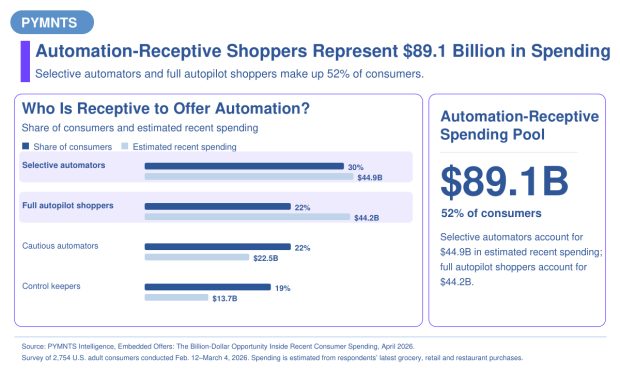
Embedded offers have a sizable audience before merchants, banks and brands solve for full automation. Consumers who are most receptive to automated offer management account for $89.1 billion in estimated recent spending across grocery, retail and restaurant purchases.
The finding comes from “Embedded Offers: The Billion-Dollar Opportunity Inside Recent Consumer Spending,” a PYMNTS Intelligence report produced in collaboration with FIS. The survey of 2,754 U.S. adult consumers examines how shoppers discover and redeem offers and how much control they would give an automated system. Across respondents’ most recent purchases, the report estimates $125.4 billion in spending, with $42.4 billion, or 34%, linked to missed or unredeemed offers.
Three findings show where embedded offers could change the shopping and payment experience:
We’d love to be your preferred source for news.
Please add us to your preferred sources list so our news, data and interviews show up in your feed. Thanks!
Automation-receptive consumers represent the largest spending pool. Selective automators and full autopilot shoppers make up 52% of consumers and account for $89.1 billion in combined estimated recent spending. Selective automators represent 30% of consumers and $44.9 billion in spending; they are comfortable with bounded automation such as applying the best payment method or adjusting quantities.
Full autopilot shoppers represent 22% of consumers and $44.2 billion in spending and are willing to let a system optimize payment, quantity and brand.
Offers can change more than price. Across grocery, retail and restaurant purchases, 72% of consumers changed which product they chose after seeing an offer, 71% changed how much they bought and 43% changed their payment method. Zero-effort shoppers lead payment switching at 47%, indicating that a visible, easy-to-use reward can affect which payment method reaches the transaction.
The current process still asks consumers to do much of the work. Only 13% of online offers and 10% of in-store offers are applied automatically. Consumers average 2.3 steps to redeem an online offer and 2.5 steps in-store, and 90% of offers require active consumer effort. Discovery is uneven as well: 32% of grocery shoppers, 46% of retail shoppers and 50% of restaurant shoppers noticed no offer during their most recent purchase.
Demand data points to a broader role for the checkout experience. Eighty-nine percent of consumers say having all product-level discounts visible while building a basket would be at least somewhat valuable. Eighty-one percent say embedded offers would influence where they shop, while 77% say real-time savings would influence which payment method or digital wallet becomes their default.
The data also puts limits around automation. Consumers are most willing to delegate payment-related actions, while willingness falls as automation reaches spending limits, quantity changes and brand substitution. For providers, the opportunity is to surface savings and reduce redemption work while preserving the level of control different consumers want.
At PYMNTS Intelligence, we work with businesses to uncover insights that fuel intelligent, data-driven discussions on changing customer expectations, a more connected economy and the strategic shifts necessary to achieve outcomes. With rigorous research methodologies and unwavering commitment to objective quality, we offer trusted data to grow your business. As our partner, you’ll have access to our diverse team of PhDs, researchers, data analysts, number crunchers, subject matter veterans and editorial experts.


 Add as Preferred Source