Banks spent years treating core modernization as a lengthy infrastructure project. Dhivya Suryadevara believes artificial intelligence may alter that timetable.
In a conversation with PYMNTS CEO Karen Webster, the Fiserv co-president described AI as a practical tool for rewriting operational workflows, simplifying implementations and modernizing aging banking systems without forcing financial institutions into wholesale platform replacements.
Suryadevara joined Fiserv after senior leadership roles at Stripe, General Motors and UnitedHealth Group. She said the scale of Fiserv’s banking and payments franchise, combined with its access to data and distribution, made the company well positioned for the AI age.
“What struck me right away is just the sheer scale that Fiserv has on the banking side, as well as the merchant side,” Suryadevara said.
The discussion centered on what Suryadevara called the company’s “stabilize, attach and grow” strategy, a framework she said applies primarily to the banking segment of the business. The stabilization effort focuses on servicing, operational resiliency and execution after periods of disruption tied to client support and technology incidents.
Fiserv has committed more than $150 million toward service improvements and technology resiliency initiatives spanning 2025 and 2026.
The broader objective is modernization without forcing banks into abrupt platform overhauls. Suryadevara said banks increasingly want the ability to modernize individual systems, such as teller functions or digital capabilities, while remaining on existing cores.
That philosophy also extends into payments and issuer processing, two businesses she described as among Fiserv’s strongest franchises. The payments unit includes debit processing, Zelle and account-to-account payment capabilities, while the issuer business remains anchored in credit card processing.
AI now sits at the center of that modernization effort.
Suryadevara said the technology is helping accelerate work that previously consumed years, particularly in areas such as legacy code conversion, implementations and servicing operations. She pointed to advances in rewriting COBOL-based systems and simplifying implementation processes that historically required large amounts of manual work.
“It’s about rewriting entire workflows for the AI era,” she said.
We’d love to be your preferred source for news.
Please add us to your preferred sources list so our news, data and interviews show up in your feed. Thanks!
Rather than applying AI incrementally to existing processes, Suryadevara argued banks should reconsider whether entire steps can be removed altogether. She described implementations as one example where AI can materially reduce operational friction and shorten conversion timelines.
The conversation also explored agent-based banking systems, including Fiserv’s Agent OS initiative. Suryadevara described the platform as a governed operating layer that allows banks to deploy AI agents while maintaining policy controls, auditability and regulatory oversight.
The system is designed to support three categories of agents: Fiserv-developed agents, bank-developed agents and third-party agents delivered through a marketplace model.
Those agents are aimed at operational workflows tied to areas such as compliance, fraud management, reporting and deposit servicing. Suryadevara said banks are increasingly interested in using AI to automate repetitive operational work while preserving governance controls required in regulated industries.
The push arrives as banks face mounting pressure to modernize infrastructure while preserving existing customer relationships and operational continuity. Earlier PYMNTS coverage of Fiserv’s issuer business framed that transition as a shift away from treating processing as invisible back-office plumbing and toward viewing it as a strategic layer tied to data, credentials and decisioning.
Suryadevara suggested AI may further raise the stakes because banks increasingly need systems capable of supporting real-time data access, automated workflows and emerging payment models.
“There’s such an opportunity to deploy AI and simplify workflows at scale, but also in a very responsible, compliant way,” she said.
Additional Takeaways
- Fiserv notes that banks increasingly want open API ecosystems that allow them to integrate FinTech partners and third-party services without losing control of core infrastructure.
- Suryadevara said AI is already being used inside servicing operations to resolve client tickets before they reach human agents.
- The company sees agent marketplaces as a future business opportunity because banks may increasingly purchase workflow-specific AI tools through governed platforms.
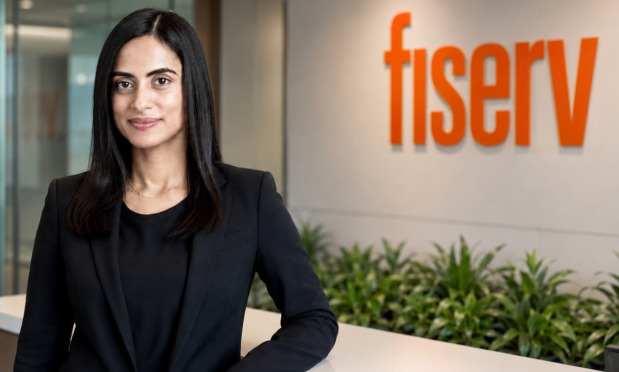
Dhivya Suryadevara is co-president at Fiserv, where she oversees the company’s financial solutions business.
PYMNTS CEO Karen Webster is one of the world’s leading experts in payments innovation and the digital economy, advising multinational companies and sitting on boards of emerging AI, healthtech and real-time payments firms, including a non-executive director on the Sezzle board, a publicly traded BNPL provider. She founded PYMNTS.com in 2009, a top media platform covering innovation in payments, commerce and the digital economy. Webster is also the author of the NEXT newsletter and a co-founder of Market Platform Dynamics, specializing in driving and monetizing innovation across industries.


 Add as Preferred Source