The last decision a bank hands to a machine will likely be one that its employees will still have to explain to a customer or regulator.
Releasing an account flagged for complex fraud activity or granting credit beyond established limits requires a financial institution to accept consequences that extend beyond the immediate decision. Automating the approval leaves the institution responsible for the outcome.
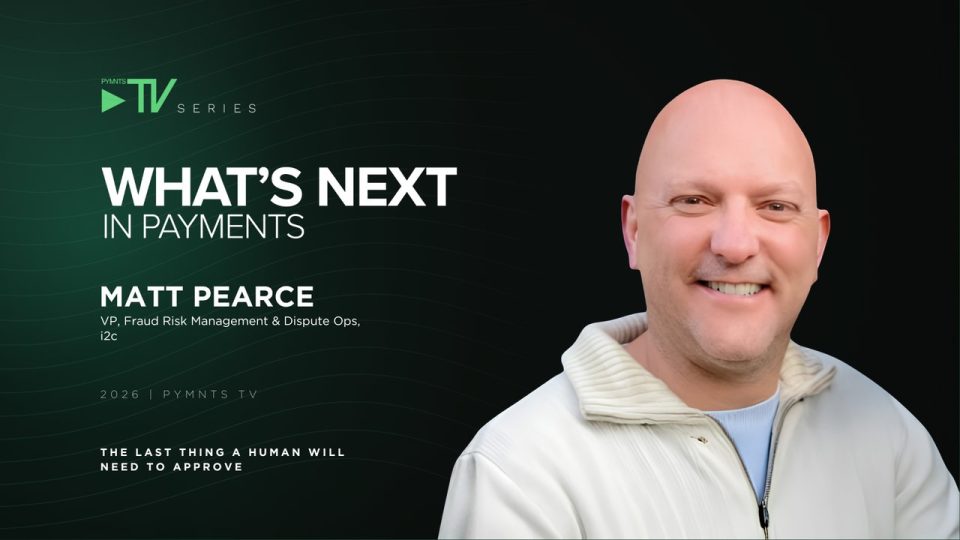
Matt Pearce, vice president of fraud risk management and dispute operations at i2c, said he expects these exceptions to preserve a role for human judgment as automated systems assume more work. Pearce oversees fraud risk management and dispute operations for processing programs serving millions of cardholders on i2c’s unified platform.
In the What’s Next in Payments interview, “The Last Thing a Human Will Need to Approve,” Pearce described artificial intelligence agents operating under restricted authority within a broader system of controls.
In the near term, “autonomous agents will execute decisions within predefined guardrails while governance policies will establish the limits of those agents’ authorities,” Pearce said.
Pearce said he expects human work to shift toward designing controls, setting policies and monitoring outcomes as individual approvals recede. Employees would supervise autonomous decisions, retaining a role in determining how the systems operate. He described that transition as an evolution from operator to supervisor, with people continuing to govern automated activity.
A single agent with unlimited authority over the entire process is unlikely, Pearce said, describing instead a framework combining AI models, fixed rules, real-time risk scoring, behavioral analytics and continuous monitoring. Each contributes to decisions governed by the financial institution’s policies and tolerance for risk. For example, an agent approves a routine dispute while a flagged pattern sends the case to a person.
Delegation under that arrangement requires institutions to specify the scope of an agent’s discretion. Expanding its permissions also requires confidence that its actions remain explainable and subject to review.
The decision to remove human approval rests partly on whether an institution is prepared to stand behind the automated result. People reviewing consequential exceptions may assess context absent from the data available to a model, Pearce said.
“First and foremost, accountability cannot be outsourced,” he said.
We’d love to be your preferred source for news.
Please add us to your preferred sources list so our news, data and interviews show up in your feed. Thanks!
The financial institution deploying the decision framework remains accountable to customers and regulators, Pearce said. Technology providers, model developers and platform partners contribute to the process, but their participation doesn’t discharge the institution’s obligations. Vendors remain responsible for the integrity of their technology.
The Exceptions People Still Approve
Most daily decisions on i2c’s platform are already automated, with human intervention generally reserved for actions outside established parameters, Pearce said.
He offered three examples of releasing an account with complex fraud activity or indications of potential fraud, approving a substantial credit line increase beyond predefined limits and overriding compliance-related restrictions. These decisions can require someone to weigh regulatory, business and customer considerations together.
An account release, for example, requires consideration of the fraud exposure associated with departing from existing controls. A credit increase outside established parameters requires approval beyond the authority already built into the automated process.
“The last human approval point is most likely to survive wherever the cost of being wrong is the highest,” Pearce said.
Humans will likely remain involved in high-stakes exceptions for at least the next three to five years, particularly in fraud, compliance, credit risk and customer disputes, Pearce said. His estimate concerned these exceptions rather than every payment authorization or account action.
“Once institutions are confident they can explain, govern and then stand behind the automated decision, that final button, that final human in the loop could disappear,” he said.
Watch the full interview with Matt Pearce to learn more about:
- How institutions can limit an autonomous agent’s authority.
- Which policy exceptions still require human judgment.
- What must change before institutions remove a final approval.
For all PYMNTS AI coverage, subscribe to the daily AI newsletter.

 Add as Preferred Source