Payment problems don’t stay hidden inside the back office. When a customer reaches checkout, and a payment fails, stalls or gets declined for the wrong reason, the business may lose the sale and the customer’s trust. That’s why more companies are investing in payment orchestration, which helps manage multiple payment providers, route transactions and keep payments moving when one provider has a problem.
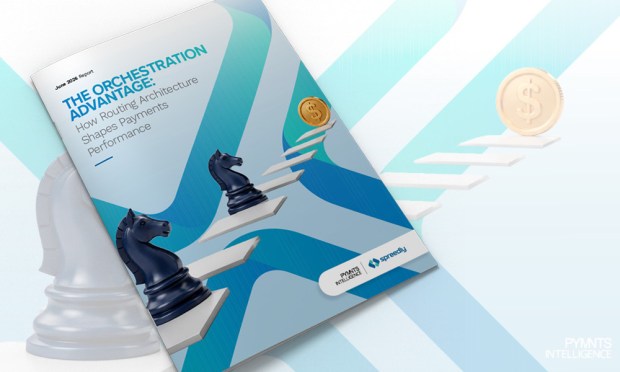
“The Orchestration Advantage: How Routing Architecture Shapes Payments Performance,” a PYMNTS Intelligence and Spreedly collaboration, finds that many companies have already made those investments. Nearly nine in 10 companies have failover or backup routing in place. Yet many are still not seeing the performance they expected. Only 47% of companies achieve transaction approval rates above 97% in a typical month, and more than half experience payment disruptions at least monthly.
This is because payment orchestration works best when companies use a full set of capabilities together. The report identifies five core capabilities that shape performance: automated routing, frequent routing logic updates, failover redundancy, control over payment tokens and the ability to add new payment rails with less friction. Companies with all five capabilities are much more likely to improve checkout completion, maintain uptime and resolve payment issues faster.
Partial progress isn’t enough. Companies with only three or four orchestration capabilities often incur greater complexity without realizing much benefit. They may have multiple tools or providers, but struggle to switch routes quickly, add payment options or move away from a provider that is not performing well.
The report also shows that token control is a major issue. Most companies don’t fully control the digital credentials tied to customers’ saved payment methods. That can make switching providers slow, expensive and difficult. It also limits a company’s ability to negotiate, test new providers or respond quickly when payment performance slips.
We’d love to be your preferred source for news.
Please add us to your preferred sources list so our news, data and interviews show up in your feed. Thanks!
Download the Report
The Orchestration Advantage: How Routing Architecture Shapes Payments Performance
In “The Orchestration Advantage: How Routing Architecture Shapes Payments Performance,” learn how:
- Companies can move from basic backup routing to a payment setup that improves checkout performance.
- Token ownership can reduce the cost and pain of switching or adding payment providers.
- Faster provider onboarding and easier payment rail integration can help firms become more flexible, resilient and competitive.
Inside the Report
“The Orchestration Advantage: How Routing Architecture Shapes Payments Performance” is based on a survey of 110 U.S. companies with annual revenue of $10 million or more conducted March 16–31, 2026. The report examines how companies structure their payment orchestration strategies and how those structures translate into measurable outcomes across authorization performance, operational flexibility, resilience, and customer experience.
The research focuses on how payment orchestration maturity and capability depth shape authorization rates, PSP onboarding speed, routing efficiency, cost control, and checkout completion gains. The sample spans five industries (finance and infrastructure, commerce, personal and property services, professional services and media, and other), three revenue bands, and includes companies using a range of orchestration approaches, from single-provider setups to dynamic multi-provider architectures. This research was independently designed, fielded, analyzed, and written by PYMNTS Intelligence. Spreedly provided funding support but exercised no control over methodology, data collection, findings, or conclusions.


 Add as Preferred Source