The cost of getting to work is starting to determine who gets to work.
Transportation problems are causing lower-paid workers to miss shifts, lose income and turn down jobs they can’t reliably reach, according to new PYMNTS Intelligence research. The effects extend beyond a more expensive fill-up. They can shape future earnings and how employers view worker reliability.
We’d love to be your preferred source for news.
Please add us to your preferred sources list so our news, data and interviews show up in your feed. Thanks!
The report, “When the Drive Isn’t Worth the Pay: How Fuel Costs Reshape Who Can Afford to Work,” is the latest edition of the Wage to Wallet Index, produced in collaboration with WorkWhile. It examines Labor Economy workers, including hourly, gig, seasonal and shift-based employees who earn no more than $25 an hour and typically less than $50,000 a year. The report found that transportation consumes 3.6% of their monthly pretax pay, close to the 3.3% reported by higher earners. The difference is that lower-paid workers generally have less savings available to absorb the added expense.
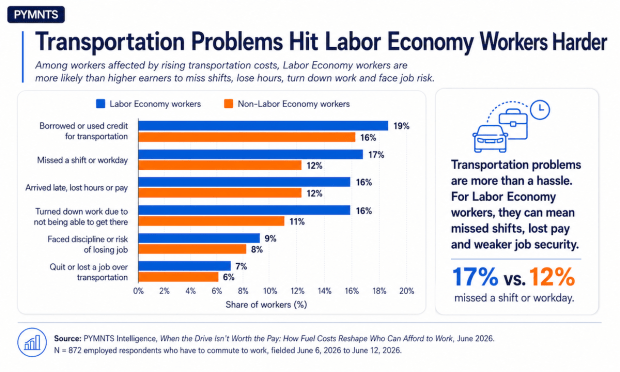
The report’s key finding shows how that weaker financial cushion can turn a commute problem into an employment problem:
- 17% of affected Labor Economy workers missed a shift or workday, compared with 12% of higher earners.
- 16% arrived late and lost hours or pay, while another 16% turned down work because they couldn’t get there.
- 19% borrowed or used credit to cover transportation, compared with 16% of non-Labor Economy workers.
Transportation now works like an admission fee for employment. Workers must cover the cost before they earn the first dollar, and some shifts no longer generate enough income to justify the trip.
Repeated disruptions can carry longer-term consequences. Nine percent of affected Labor Economy workers faced discipline or the risk of losing a job, while 7% quit or lost work because of transportation problems. Employers and labor platforms may also offer fewer future shifts to workers who arrive late or decline assignments.
The report also identifies room for practical solutions. Banks, FinTechs and payments providers can offer low-fee instant pay, fuel rewards, savings tools and cash flow alerts. Workforce platforms can match workers with jobs closer to home and show estimated take-home pay after commuting costs. Those tools could help employers fill shifts while giving workers a clearer view of whether the drive will leave enough money in their wallets.


 Add as Preferred Source