Loyalty used to be a relatively simple fight for spend primacy. Issuers wanted the card at the front of the wallet, then the default credential on file.
But the architecture beyond loyalty programs remained fundamentally deterministic no matter the surface upgrades. The customer journey was mapped in advance, loyalty programs rewarded past behavior and personalization was mostly conditional logic disguised as intelligence.
That’s all changing now as payments become more contextual, and more AI-driven.
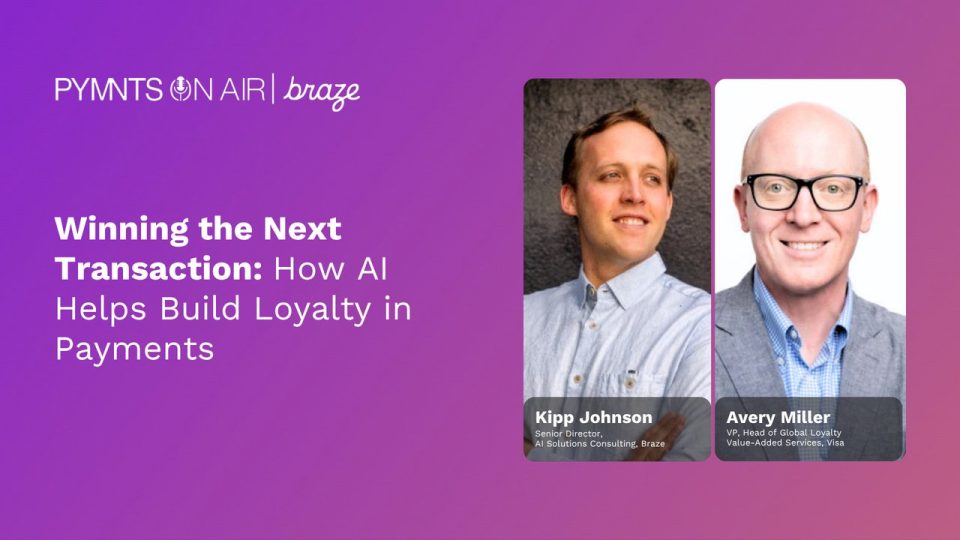
To hear more about why the old rewards model is giving way to something more dynamic, PYMNTS sat down with Visa Vice President, Head of Global Loyalty for Value-Added Services Avery Miller and Braze Senior Director, AI Solutions Consulting Kipp Johnson.
“I do think issuers are in fact still trying to get to top-of-wallet,” Miller said, “but I think that job is rapidly changing for them.”
Consumers, he added, are increasingly willing to change payment methods depending on the circumstance. That means financial institutions are “fighting for every transaction” if they want to remain the primary financial relationship.
Johnson framed the same shift from the marketer’s side. Loyalty, he said, has become “an explosion of different combinations of what each customer’s experience could be,” meaning that brands can no longer rely on static segments or predefined journeys.
“Everybody’s experience with your brand is as unique as they are,” Johnson said.
The old loyalty moat was card issuance. The next moat is emerging around decisioning intelligence.
Winning the Next Transaction: How AI Helps Build Loyalty in Payments
Rather than rewarding consumers after the fact, artificial intelligence allows institutions to intervene during key decision-making moments like when a customer is considering a purchase, evaluating an offer or reassessing a relationship. Instead of asking what offer should be sent to a broad population, companies can ask what intervention makes sense for this customer, in this context, at this moment.
The downstream consequence of the loyalty landscape’s shift toward probabilistic commerce could be enormous. Issuers, merchants, networks and FinTechs are all about to compete inside the same real-time AI mediation layer.
Braze’s Johnson underscored that the move from rules-based automation to AI-driven journeys will help create “hundreds of thousands or millions of different permutations” for customers during onboarding or activation. And this isn’t the far away future, or even the near future. It’s already happening.
For banks, Miller said, the opportunity is to treat loyalty as broader than card rewards. “A big part of it, I think, for financial institutions, is to make sure that they’re thinking about value outside of the specific transaction,” he said.
That could mean using a subscription-management moment to present a relevant merchant offer before a customer cancels, preserving value for the consumer, the issuer and the merchant.
“Agentic commerce is only going to accelerate that transition and create a world of near-perfect information for the buyer,” Miller said.
We’d love to be your preferred source for news.
Please add us to your preferred sources list so our news, data and interviews show up in your feed. Thanks!
Because once AI agents can compare offers, rewards, financing options, merchant incentives and contextual utility instantly, traditional loyalty economics may begin compressing toward zero differentiation.
Personalization Moves From Static Rewards to Adaptive Experiences
The risk is that firms mistake more content, more offers and more automation for better loyalty. In a world of better information and thinner margins, the differentiator becomes the broader experience: the affinity moments around the financial product, not just the rewards attached to it. The goal is to deliver the right context at the right moment so AI can make a better decision on behalf of the customer.
“My job now becomes removing the load, removing the onus from the consumer,” Miller said, giving the example of a coffee offer sent near a café which may be personalized, but not useful if the customer is running late.
Johnson described today’s emerging loyalty discipline as “context engineering,” where the challenge is not simply gathering more data but understanding which signals matter in a given moment. The danger, he noted, is overwhelming systems with irrelevant information. More data does not necessarily produce better outcomes.
After all, as has traditionally been the case with loyalty, the hardest part is the data. Johnson warned that waiting for perfect data is a trap. Companies should begin with data they trust, even if the initial set is narrow, then use early value creation to pull more data into the system.
Miller added that even banks who have strong product-level data may not have the full picture, which can be important particularly when institutions are trying to understand spending patterns across an entire household relationship.
The Future of Loyalty Belongs to Invisible Reliability
Artificial intelligence will not solve every strategic problem. Johnson said some loyalty challenges are business-model questions, not technical ones. “AI is very good at optimizing when you can tell it the value of something,” he said. “It’s not always great at telling you what the value of something is.”
The winners may not be the institutions with the richest rewards programs, but those with the lowest-friction ecosystem experiences, strongest predictive intelligence, and best failure recovery mechanisms. The future loyalty executive may resemble a behavioral systems architect more than a traditional marketer.
Johnson hinted at this when he said marketers are “positioned to be successful” with AI.
“They are used to the blend of art and science to figure out the context that is most important for the decisioning system to be able to make the appropriate decision for each individual customer,” he said.
Ultimately, AI does not create loyalty. It makes loyalty harder to fake. Issuers and merchants will need better data, sharper context and more disciplined measurement. The prize is no longer merely a card at the top of the wallet. It is the right to be chosen, transaction by transaction.


 Add as Preferred Source