Consumers seeking to build credit can face a difficult cash decision: How much money they can afford to set aside before using a secured card.
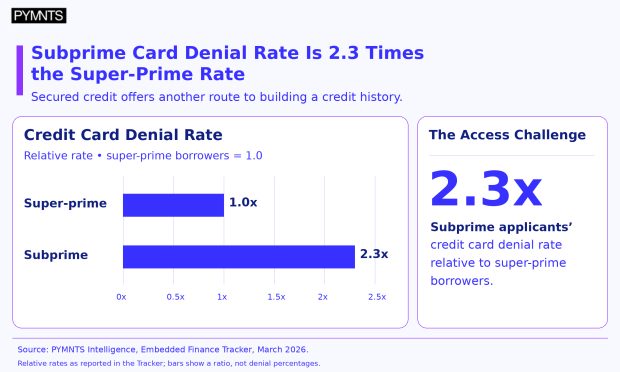
That funding requirement is central to “Secured Credit’s Next Turn: Unlocking Growth With Dynamic Funding,” the March 2026 edition of PYMNTS Intelligence’s “Embedded Finance Tracker,” produced in collaboration with Galileo. The report cites research showing that subprime applicants face a credit card denial rate 2.3 times that of super-prime borrowers. Secured credit offers another route to establishing a repayment record. Its usefulness, however, depends partly on whether consumers can manage the deposit alongside their other expenses.
We’d love to be your preferred source for news.
Please add us to your preferred sources list so our news, data and interviews show up in your feed. Thanks!
Traditional funding can tie up money consumers need elsewhere. In the legacy model, a customer seeking a $500 secured credit limit places $500 in a locked collateral account. After spending $100 on the card, the customer must repay that purchase from checking while the original deposit remains unavailable. The example illustrates the burden of maintaining collateral and repayment funds at the same time. A product intended to support credit building can require a substantial commitment of cash before that process begins.
Dynamic funding changes how much of the deposit is secured. There’s an alternative scenario wherein a consumer deposits $500 and spends $100. Only $100 becomes secured, leaving $400 liquid. A single available-to-spend balance supports debit and secured credit transactions. For a household deciding whether to enroll, access to unused funds could make the product easier to fit into a monthly budget. The deposit still supports the credit activity, but the consumer retains more flexibility over money that has not been spent.
Clear balances matter after the first purchase. The report describes how manual transfers and delayed updates can complicate traditional secured credit. Customers may struggle to reconcile their spending capacity with the credit limit displayed elsewhere. For issuers, the corresponding work includes reconciliation, exception handling and disputes over funding. Automating those movements could help customers understand what they can spend while giving service teams fewer timing questions to resolve.
The commercial case depends on delivering that simpler experience consistently. Credit interchange is another reason for issuers to consider secured cards, since it is not subject to the same caps as debit interchange. There’s a need to make funding and balance information easy to follow throughout the account relationship. For consumers trying to establish credit, the ability to keep unused money available could be an important reason to start using the product.
At PYMNTS Intelligence, we work with businesses to uncover insights that fuel intelligent, data-driven discussions on changing customer expectations, a more connected economy and the strategic shifts necessary to achieve outcomes. With rigorous research methodologies and unwavering commitment to objective quality, we offer trusted data to grow your business. As our partner, you’ll have access to our diverse team of PhDs, researchers, data analysts, number crunchers, subject matter veterans and editorial experts.


 Add as Preferred Source