Stablecoins were supposed to make payment networks less necessary. Visa’s new stablecoin platform, introduced Thursday (July 16), suggests a different outcome.
The move comes on the heels of Visa’s June announcement that it had joined a 140-plus member Open Standard consortium to launch Open USD (OUSD), a dollar-backed stablecoin. The technical act of transferring a stablecoin is relatively simple. The institutional act of operating with one is not. In a future that progresses linearly from now, stablecoins may not bypass the networks after all. They may become another product the networks package, govern and monetize.
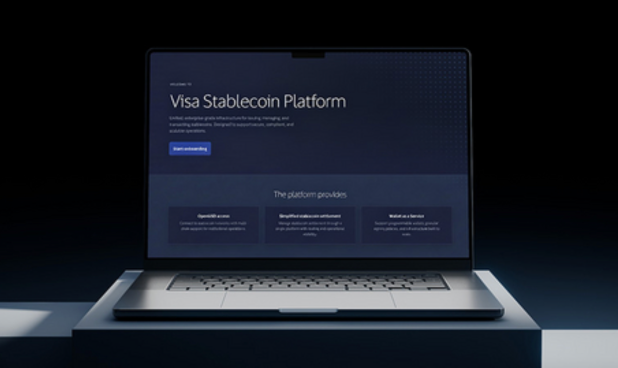
Visa’s new Visa Stablecoin Platform (VSP), now in beta with select clients, gives financial institutions, FinTechs and crypto companies a single managed environment for minting, redeeming, holding and transferring stablecoins. The platform initially supports Open USD and includes wallet infrastructure, bank-account connectivity and institutional controls such as dual approvals, audit logs, secure passkeys and transfer allow lists.
The immediate product pitch is about simplifying stablecoin adoption. The more consequential strategic move is that Visa is positioning itself to manage the operating environment around on-chain money, even when the underlying value no longer travels through a conventional card transaction.
Blockchains provide the settlement rail. Stablecoins provide the digital asset. But neither automatically provides the permissions, workflows, reporting and interoperability that regulated businesses need. Those functions sit above the blockchain, and Visa is attempting to turn them into a managed service.
See also: Nobody Told the ERP That Blockchain Won
The Real Product Is Not the Stablecoin, It’s the Reconciliation
Much of the early stablecoin market was organized around individual issuers, wallets and networks. Institutions had to choose an asset, select one or more blockchains, arrange custody or wallet infrastructure and assemble the compliance and fiat connections around them. That fragmentation created an adoption problem. The more stablecoin and blockchain options emerged, the more integration decisions an institution had to make.
Fast forward to today, and stablecoins may change how money moves without substantially changing who makes that movement usable. Stripe’s failed bid for PayPal had a similar strategic element to Visa’s VSP launch in that the acquisition, had it been successful, aimed to abstract away the infrastructure around stablecoin payments then ultimately sell the resulting capability to businesses and merchants.
A bank or FinTech can’t just go ahead and create a wallet, buy digital dollars and begin moving corporate liquidity across a blockchain. It must determine who has authority to initiate a transaction, who must approve it, which destinations are permitted, how private credentials are protected and how every action will be reconstructed for compliance teams, auditors and regulators. To do that, the bank or fintech must also connect any blockchain activity to bank accounts, treasury systems, liquidity controls and existing accounting processes.
These less glamorous requirements are becoming a potentially valuable enterprise software category.
Read more: Open USD Just Turned the Stablecoin Race Into an Ecosystem Contest
We’d love to be your preferred source for news.
Please add us to your preferred sources list so our news, data and interviews show up in your feed. Thanks!
Payment Networks Can Sit Above Everyone Else’s Blockchain Rails
The stablecoin debate has often been framed as a competition between legacy payment infrastructure and blockchain-based alternatives. Visa’s platform suggests the lines may be less distinct. The winning stablecoin infrastructure is likely to be the infrastructure that makes the underlying asset and blockchain least visible to the institution using them. This is also something that industry experts have separately and repeatedly stressed in conversation with PYMNTS.
Established payment companies can adopt blockchain settlement while retaining control over the customer relationship, compliance framework and operating interface. Crypto firms can gain access to institutional clients without having to recreate the global distribution and risk-management capabilities of a major network.
The result could be less disruption than recombination.
Tempo Go-To-Market Lead Dan Romero argued on an earlier episode of “From the Block,” the PYMNTS podcast hosted by CEO Karen Webster and Citi Global Head of Digital Assets, Treasury and Trade Solutions Ryan Rugg, that cryptocurrency has evolved into what he called a “barbell economy” split between speculative markets and real-world payments rails.
The survivors in digital assets, Romero said, are the businesses focused on a far less ideological problem: moving money better. Many of crypto’s most ambitious consumer experiments, from decentralized social networks to mass-market apps, never gained traction. Romero himself spent years building Farcaster, a decentralized social protocol, before concluding that much of the sector’s consumer vision “didn’t work.”
“Most of what has happened in crypto over the last decade has not really impacted the real world,” he said.
See more: Stablecoins Are Just Wildcat Banking With Better Wi-Fi
The direction of travel across the stablecoin landscape is a revealing one. Visa is not treating stablecoins merely as a faster settlement instrument or a threat to card volume. It is treating them as a new category of enterprise money that requires distribution, governance and operational tooling.
The card networks became powerful by standardizing how institutions connected to electronic payments. Stablecoins give Visa an opportunity to repeat that play at a different layer of the financial system.
Still, the PYMNTS Intelligence report “Waiting for Certainty: Why Most CFOs Are Holding Back on Crypto and Stablecoins,” the March installment of the 2026 Certainty Project, showed that most middle-market companies remain cautious about digital assets. Usage is limited, with 13% of firms using stablecoins and 5% employing other cryptocurrencies.


 Add as Preferred Source