Paycheck-to-Paycheck Consumers Have Already Cut the Lattes
Meet Tom and Elaine. (Our names, not theirs.)
Both report household income between $65,000 and $70,000. Both are married, live in a city and say day-to-day spending is why they live paycheck to paycheck. For both, the next paycheck is critical to meeting their monthly financial obligations.
On paper, they’re the same consumer. A bank, lender, merchant or financial adviser would put them in the same box.
Then ask what each could cut if the budget got tighter. Elaine says she could find a few things if push came to shove. Tom says he’s already hit the wall.
Dig deeper and the answers look backward. Elaine has between $2,501 and $5,000 in savings, roughly six weeks of spending, and buys across 11 of the 22 spending categories PYMNTS Intelligence tracks. Tom has between $10,001 and $15,000, more than twice as much and nearly 13 weeks of spending yet buys across only three.
Elaine believes she can eventually stop living paycheck to paycheck. Tom says no way, no how for as far as his eyes can see. Elaine’s next cut is a lunch out or a subscription. Tom already made those cuts. Whatever he gives up next, the whole household will feel.
Read More: How Affordability Became America’s Conversation
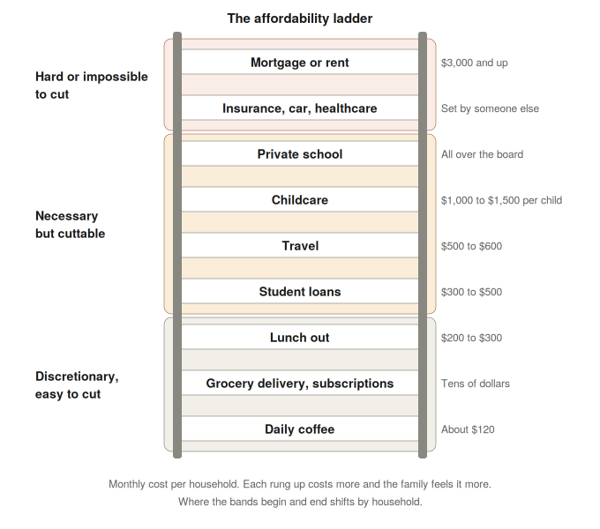
Think of household spending as an affordability ladder.
Every expense sits on a rung. The rungs at the bottom are cheap and somewhat easy to give up. The daily coffee, the lunch out, the streaming subscription. Nobody outside the household notices when they go.
The rungs in the middle are what consumers call necessary but cuttable if things get tight. Travel, the student loan payment, childcare, private school. Each one costs hundreds or thousands of dollars a month and giving it up changes how the family lives.
The rungs at the top are hard or impossible to cut without upending the household. The mortgage or rent, insurance, the car.
Every household starts cutting at the bottom and climbs. The higher a household has climbed, the more the next cut costs and the more the family feels it. Where the lines between the bands fall is different for every household, and that’s the point.
And it’s the divide inside the paycheck-to-paycheck economy that matters most to a business.
Income, savings and spending put Tom and Elaine in the same box. The next cut puts them on different rungs of the affordability ladder. At the bottom, giving something up costs little with substitutes that make the cut feel sort of okay. Near the top, it costs the family a routine, a job or a home. “Just cut back” is easy advice for Elaine. For Tom, it means more significant financial consequences.
Since 2021, PYMNTS Intelligence has tracked who lives paycheck to paycheck, who doesn’t and who struggles to pay the bills every month. We’ve compiled a massive data set on the now 67% of U.S. adults who say the next paycheck is essential to pay the bills.
In July, we went a level deeper. We asked why households say they live paycheck to paycheck, where they draw the line between essential and discretionary spending, what they could still give up if the budget got tighter, and what it would cost them to do it.
We asked a national sample of 2,881 U.S. consumers about 22 spending categories, from mortgages, insurance and cars to childcare, student loans, subscriptions, lunches out and travel. Consumers told us which expenses end up in their baskets and whether each one is essential, discretionary or a spending choice that still feels necessary.
The answers tell us how the household budget got built, how far up the affordability ladder each household has already climbed and what the next cut costs.
Two households can earn and save similar amounts and stand on very different rungs.
How Households Got Here and How Far They’ve Already Climbed
Let’s start with how paycheck-to-paycheck households say they got here.
For 41%, day-to-day spending absorbs the paycheck. Another 31% are recovering from a short-term financial shock such as a job loss, medical bill or major repair. The remaining 28% say long-term choices around housing, education, childcare, family support or debt put them here.
Figure 2
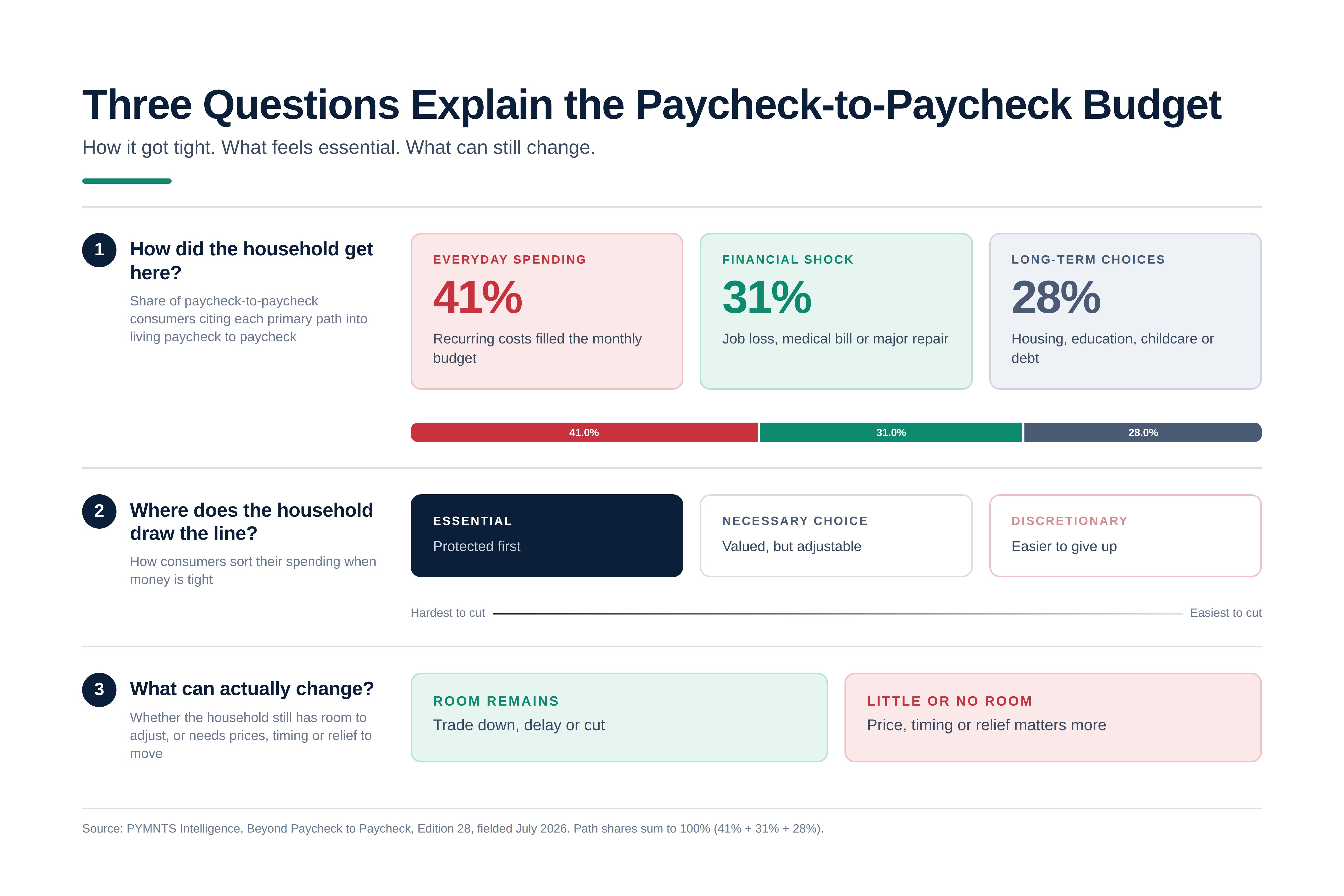
Those three paths explain how the budget was built. They don’t explain how far up the affordability ladder the household has climbed. A household shaped by long-term choices can still be trimming lunches or already be down to the mortgage.
Tom and Elaine prove the point. Both got here through day-to-day spending. Elaine still has purchases she can trade down, delay or drop without anyone noticing. Tom says he has none.
Roughly a third of households who point to everyday spending or a financial shock for their status also say there’s nothing left to cut. Their baskets aren’t empty, but cheap rungs for trading off or cutting out are exhausted. What’s left is the car, the childcare, the rent. Telling them to skip the avocado toast isn’t helpful. It assumes spending that no longer exists and misses the more obvious point. The next thing on the list to cut has consequences the whole household can feel.
Read More: Who Is the Paycheck-to-Paycheck Consumer in America?
The households shaped by long-term choices are different for another reason. They started near the top of the affordability ladder. Their line between essential and discretionary runs through costs that started as choices and now organize how the family lives: the house, the school, the childcare arrangement, the degree still being paid for. Cutting them means moving, changing schools, finding different childcare or refinancing debt. None of that happens in a month or maybe even a year.
So “just cut back” means something different in each household. For Elaine, it’s a smaller basket. For Tom, it’s a decision the family will feel. For the household with long-term obligations, it’s whether a budget built at one set of prices still works after insurance, taxes, tuition or childcare move higher, and what breaks if it doesn’t.
That gives businesses three questions worth asking about the more than two thirds of Americans who say they live paycheck to paycheck.
What expense rung is this household on? What does the next cut cost them? What would let them keep it?
The answers define the affordability crisis in America. And determine whether the next price increase triggers a trade-down, a search for a better offer or term, or trouble paying the bill.
Affordability Lives Inside the Monthly Budget
It’s also why the mainstream media discussion of affordability, interest rates and CPI misses the larger point. Consumers don’t pay an inflation rate. They pay today’s mortgage or rent, insurance premium, healthcare bill, grocery total, car payment and childcare invoice. Those costs rose, stayed high and kept claiming a larger share of the paycheck even as inflation eased from its peak. Nobody needs a PhD in economics to notice what the grocery cart costs now.
Read More: The Three Blind Spots in How Consumer Sentiment Is Measured
A job makes a consumer feel reasonably (nervously?) okay because another paycheck is coming. It can’t make fixed costs cheaper. That’s why the same consumer can tell our Consumer Expectations panel they feel fine about their prospects and tell our paycheck-to-paycheck panel there’s less room in the budget if things get tight. A household can be current on every bill, confident the job will be there next month and have almost nothing left to cut.
Income alone doesn’t fix it. Households shaped by long-term choices have a median income of $92,500, and more than a third earn at least $150,000. They’re also more likely to have a mortgage, childcare and tuition obligations and student debt. That helps explain why half of consumers earning $100,000 or more say they live paycheck to paycheck.
They chose the house, the school or the degree financed with student loans. They didn’t choose the insurance increases, higher tax bills, grocery bills that make a dent in the household budget and rising childcare costs that came later.
Consider one household in our data. She’s a 52-year-old married mother living in the suburbs. Her household earns between $100,000 and $125,000 and has less than one week of savings. She calls the mortgage the one expense she regards as essential and says she didn’t cut spending last quarter because she didn’t need to. Her budget works today. One more increase and it may not. This group’s median cushion is 7.4 weeks, yet nearly three in ten have two weeks or less.
Cutting Lattes Is Easy. Cutting Tuition Isn’t.
“Just cut back” treats every expense as the same kind of decision. Skipping the latte costs the consumer little and saves something like six bucks a day. Canceling grocery delivery costs them an hour on Saturday. Skipping the family trip costs a summer family tradition. Dropping childcare could cost someone a job. Pulling a kid out of private school or selling the house rearranges the family, and it takes months, not a phone call or toggle off on an app.
The dollars climb the same ladder. Let’s assume that a daily coffee habit runs about $120 a month. Lunch out, $200 to $300. Travel, $500 to $600. Student loans, $300 to $500. Childcare, $1,000 to $1,500 per child. Private school, all over the board. A mortgage, $3,000 and up. A month without lattes covers roughly one week of daycare. That’s the arithmetic behind why the advice to “just cut back” lands on deaf ears for so many.
Read More: 65% Call Insurance Essential. Why Most Spending Isn’t So Clear-Cut
We asked consumers to sort each of the 22 expenses in their baskets as essential, discretionary or a spending choice that still feels necessary to learn more about how household budgets hold up when expenses rise. We find that it’s the middle category where the money and the risk sit. Consumers won’t go as far as to call these expenses essential, but they won’t suggest that they are easy to drop either.
For households with wiggle room, the middle band is full of cheaper expense rungs. One-third call lunch out and grocery delivery flexible, and 39% say the same about travel. The expensive rungs are still protected. Two-thirds call private school essential. Half say the same about childcare.
Households with no room left have already climbed past those cheaper rungs.
What’s left to flex is the expensive stuff, and those are harder choices to make. Among the few still paying for private school, roughly half now call it a choice they could reconsider. For childcare, more than four in ten. Student loans, about four in ten. Travel, about the same. For student loans, cutting rarely means walking away. It means pausing, stretching or refinancing the payment, and paying more later. Their next cut is a $1,000-a-month decision with a family impact attached.
Households shaped by long-term choices sit somewhere in between, and they barely have a bottom of the ladder at all. Only 6 to 12% of them call childcare, private school or student debt discretionary. Their cuttable list starts at student loans and goes up from there.
These budgets were built at different prices, too. The house, the school, the car and the childcare arrangement were chosen in 2019, 2020 or 2021. Groceries alone cost about a third more than they did in January 2020, according to the Bureau of Labor Statistics’ food-at-home price index, and most of that increase had landed by early 2023. It never came back down.
Read More: Tariffs. Who Really Pays.

We’d love to be your preferred source for news.
Please add us to your preferred sources list so our news, data and interviews show up in your feed. Thanks!
 Add as Preferred Source
The household didn’t change its commitments. The price of keeping them did.
The ladder shows what it costs to stop. Across all consumers, reported flexibility is the better predictor of action. Nearly a third (31%) of those who say they have quite a bit or a great deal of flexibility cut spending meaningfully last quarter, compared with 9% of those who say they have very little or none. Elaine’s options are still sitting on the cheap rungs. Tom is looking up at the expensive ones.
Why Consumers Can Feel Okay and Still Be Squeezed
The PYMNTS Consumer Expectations Index tells the other half of the paycheck-to-paycheck story. The headline reading has held in a narrow band. Underneath it, the groups are pulling apart. Consumers who struggle to pay their bills sit below the average.
Those living paycheck to paycheck but staying current have eroded gradually. Consumers with more cushion have drifted higher. Employment is holding up the mood. Affordability is sorting the experience.
So, forget the K-shape. This is an E-shape economy, and the lines are drawn by which rung of the ladder each group is standing on.
Households with no room have climbed to the top and are down to what they treat as fixed costs. Households with room feel okay because the paycheck arrives and the bills get paid, and they keep giving up the cheap stuff to make that true. Households shaped by long-term choices have more income and credit on average, but they started near the top, and every rung left costs more than their salaries suggest.
Jobs explain why expectations haven’t collapsed. The basket, and what’s in it, explains why stability still feels fragile. That fragility shows up long before a late-payment notice. The canceled subscription, the lunch packed at home, the coffee poured into a to-go cup instead of picked up at the Starbucks drive-through, the trip replaced by a drivable Airbnb getaway, the purchase that never happens. None of it shows up on a credit report. All of it is work households are doing to stay current and keep feeling okay.
Credit Depends on What the Next Cut Costs
This lens changes the role of credit across the paycheck-to-paycheck economy.
For households at the top of the affordability ladder, the problem is usually timing. Bills land on fixed dates and paychecks may not. PYMNTS Intelligence’s Wage to Wallet Index finds nearly a third of hourly workers incur late fees, overdrafts or penalty interest at least monthly, about $50 a month or $600 a year, a far larger bite of an hourly paycheck than of a salaried one. BNPL used responsibly as working capital can bridge that gap.
Read More: Why Buy Now, Pay Later Was Never Just About Credit
For households still on the cheap rungs, installments are one more budgeting tool next to spending cuts and side work. They’re still deciding what stays in the basket, so flexible payment options may matter more than more spending power.
For households shaped by long-term choices, the first question is whether any cheap rungs remain. If they do, installments can fit new spending beside the mortgage, tuition or childcare. If they don’t, another payment plan adds pressure. The job is lowering the cost of keeping a commitment: refinancing, term relief or a lower ongoing cost.
Agents Can Find More Options, Not Assume Them
Income, employment, savings and payment status tell an issuer, lender or merchant what comes in. They don’t say what rung the household is on or what the next cut costs. An agent can act on that in ways a static offer or generic budgeting tool can’t.
For Elaine, that means finding a lower price or better offer that lets her keep something she values. For Tom, it means automatically applying savings and rewards he no longer has the time or margin to hunt for, so the next cut gets pushed further out. For a household shaped by long-term choices, it means shopping insurance, surfacing an employer benefit or finding a payment term that lowers the monthly cost of keeping the kids where they are.
An agent can search across merchants, brands, loyalty programs, payment credentials and financing offers, compare total cost and timing, and surface savings before the purchase is made. That takes work off consumers with options and, more important, off those with little time or room to spare.
As I wrote in April in “Why the Offers Economy Is Broken,” nearly nine in 10 consumers want to see every relevant discount before they decide what goes in the cart, and seven in 10 change what they buy or how much when an offer reaches them. There’s no shortage of promotions. Consumers have to find, activate and remember them on their own, and half the time offers go unnoticed.
A tokenized payment credential can carry consumer identity, purchase history and preferences, so relevant offers get queried, surfaced, applied and attributed automatically. An agent working within rules the consumer sets can then find the merchant, offer, payment method or installment option that creates the most value without turning checkout into a research project.
Merchants get a role beyond another coupon at checkout. They can put relevant, funded offers in front of the shopper and the agent earlier, while the consumer is still deciding what belongs in the basket. Instead of waiting to be cut, the merchant gives the shopper a reason to keep it in.
People feel okay right now because they have jobs and squeezed at the same time because each cut costs more than the last one. The next phase of agentic commerce has a bigger job than helping consumers buy more. The best agents will help them make what they already earn go further, and find one more option before the answer becomes no.
Until NEXT time.
Join the 21,000 subscribers who’ve already said yes to what’s NEXT.

PYMNTS CEO Karen Webster is one of the world’s leading experts in payments innovation and the digital economy, advising multinational companies and sitting on boards of emerging AI, healthtech and real-time payments firms. She founded PYMNTS.com in 2009, a top media platform covering innovation in payments, commerce and the digital economy. Webster is also the author of the NEXT newsletter and a co-founder of Market Platform Dynamics, specializing in driving and monetizing innovation across industries.